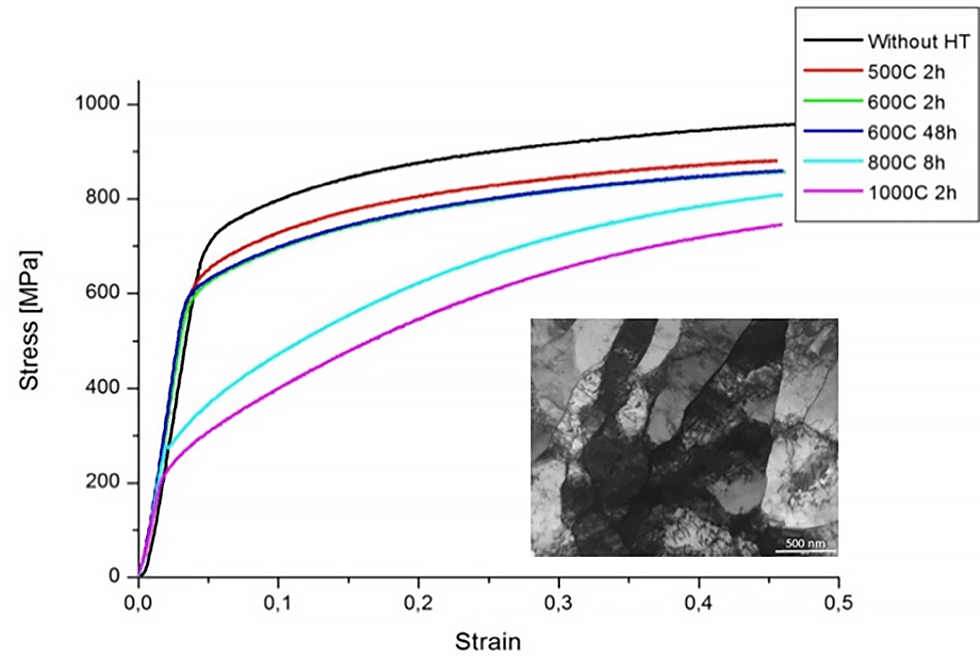
This concept is based on a thermodynamic approach predicting that certain mixtures of at least 5 elements in (almost) equi-proportions can form a stable solid solution (thanks to the high entropy of the mixture) despite the presence of several chemical elements within them. The objective of our work, in addition to academic aspects related to microstructural optimization and understanding plastic deformation mechanisms, consists of designing and evaluating “new generation stainless steels or superalloys.” This research area involves several actions:
Optimization of the A3S grade (“austenitic superstainless steel”). We are studying how the deviation from the stoichiometry established by Cantor stabilizes the solid solution at intermediate temperatures and allows for the creation of stable nanostructures under conventional thermomechanical treatment conditions.
Design of cobalt-free HEA grades. In addition to the associated economic gain, the absence of Cobalt expands the scope of application, particularly concerning the nuclear sector. Evaluation of the validity of existing databases for HEA alloy design. While good agreement has been achieved between predictions and experimental results at high temperatures (melting temperatures, phase stability, primary segregation, etc.), solid-state transformations are still unsatisfactorily described.