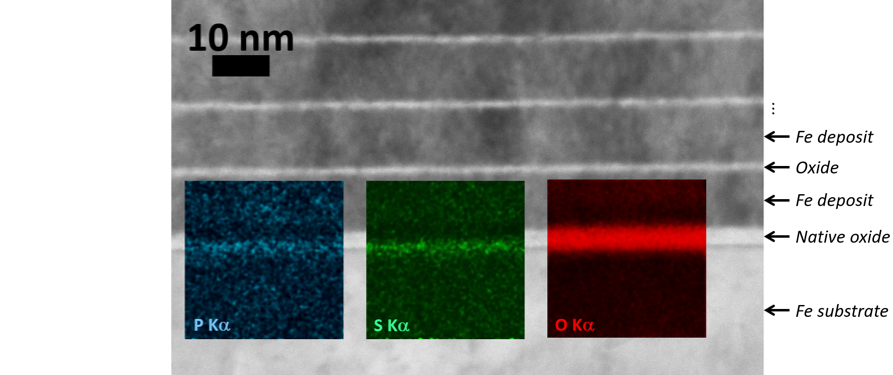
Surfaces and interfaces play a crucial role in materials science. They have been the subject of research at LGF for many years. This is particularly true within the SURF team, but not exclusively: surfaces and interfaces are present as concepts or physical objects in all four of our teams. The “Surfaces and Interfaces” theme is organized around three main areas.
Role of Surfaces and Interfaces in Material Durability
A surface can be defined as the boundary between the material and the external environment. It is therefore the primary site for degradation mechanisms, such as aqueous corrosion, high-temperature oxidation, or hydrogen embrittlement for metallic materials. Similarly, grain boundaries can constitute “weak points” in metallic materials, particularly in the presence of segregations, leading to intergranular fractures under certain thermomechanical stresses. Understanding and modeling degradation phenomena related to surfaces and interfaces constitute one of LGF’s core competencies.
In parallel with this approach of understanding and modeling, and in collaboration with our Lyon-Saint-Etienne partners, we have recently initiated a surface engineering approach aimed at counteracting degradation phenomena. Examples include the Surfadur project (collaboration with ENISE-LTDS), supported by LABEX MANUTECH SISE, which aims to limit stress corrosion cracking of stainless steel through mechanical surface treatment by burnishing, or the Hytex project (collaboration with UJM-LaHC), funded by EUR SLEIGHT, whose objective is to limit hydrogen uptake in metallic materials through laser surface texturing.

Modeling the Role of Surfaces and Interfaces in Material Processing Techniques
Considering surface and interface effects is essential for modeling certain material processing techniques. Without being exhaustive, this is particularly true in the following cases, which are currently being researched at LGF:
- Effect of surface and interface tension on the development of structural composites by resin infusion,
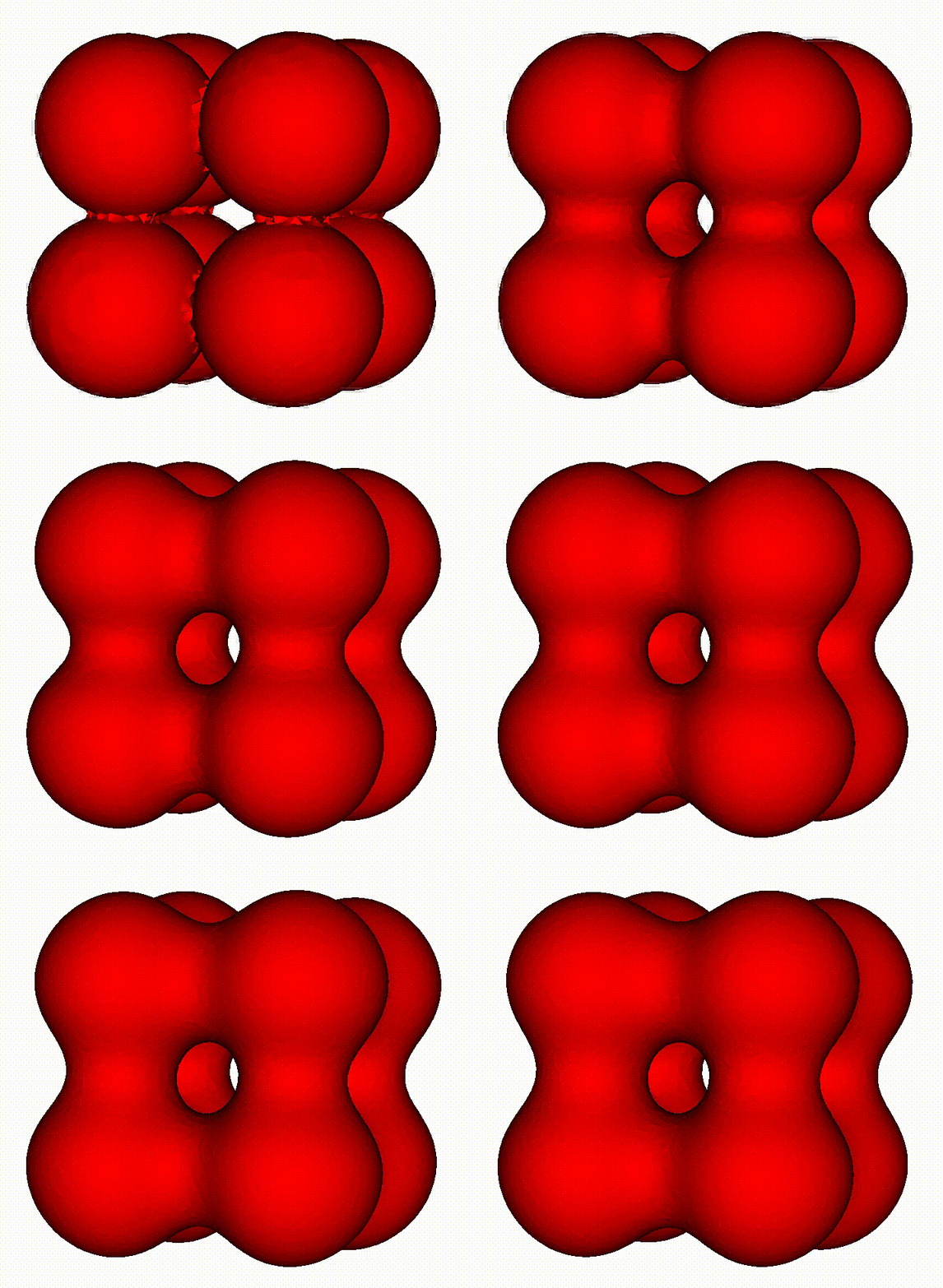
- Role of surface and interface diffusion in the sintering of ceramic materials by microwave heating,
- Impact of grain-to-grain surface interactions on the rheological properties of powders.
Methodological Developments
LGF develops experimental methodologies for characterizing surfaces and interfaces in materials. This activity is primarily organized around the following three areas:
- Quantitative methods for chemical analysis of surfaces and interfaces in materials by XPS, Auger, and STEM-EDX,
- Methods for the micromechanical study of surfaces and interfaces (nano-indentation, mechanical tests on micropillars or microbeams, grain-grain interaction measurements by AFM),
- Optical methods for characterizing colors and visual rendering.
We also develop surface treatment methods for visual rendering: colored anodization, surface texturing.