The Georges Friedel Laboratory has specialized for many years in the study of powders and granular media, particularly in the study of their behavior when subjected to thermal, chemical, or mechanical stress.
These demands, whether voluntary or imposed, raise a number of scientific and technological questions in many sectors, such as the pharmaceutical, cosmetic, and chemical industries, civil engineering, metallurgy, soil and rock mechanics, the agri-food sector, and even the nuclear and aerospace industries.
To address these questions, the LGF has developed expertise in modeling the elementary steps when a powder reacts with a gas (SURF team), and in describing granular flows specific to the geometries of various unit operations (PMDM team).
With the aim of understanding and predicting the synergies existing between these different demands, we intend to develop, on the one hand, an experimental approach using instrumented pilot plants and characterization tools for granular media, and on the other hand, a global modeling approach coupling the various phenomena involved.
Among the processes for transforming powders in contact with a gas, the rotary kiln offers the advantage of controlling both the temperature and the partial pressure of gases in the powder’s environment, while allowing continuous and regular mixing of the powder. This technology enables uniform temperature and optimized gas-solid contact, thereby producing a homogeneous product, reducing processing times, and increasing the production rate. This type of kiln is used on an industrial scale, for example, in nuclear fuel production, clinker conversion, or the thermal decomposition of siderite.
The treatment of powders in a rotary kiln involves chemical, thermal, and mechanical phenomena characterized by a wide diversity of spatial and temporal scales, making simulation challenging due to the need to reconcile model consistency and computation time.
From an experimental point of view, and in connection with the “powder technology” platform, a cold mock-up was designed, built, and instrumented by the UMR’s support workshops (mechanical workshop and metrology workshop) and the Process technology hall (design and construction of prototypes). This mock-up allows observation of the granular bed movement in a rotating drum at ambient temperature. A gas introduction system also makes it possible to study the influence of water vapor presence.
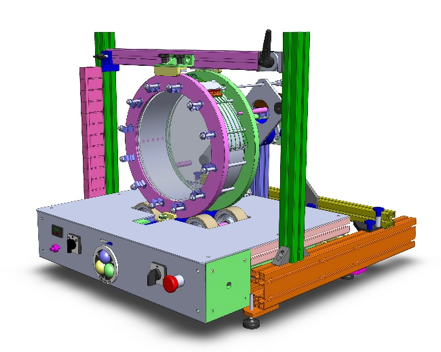
A controlled-atmosphere rotary kiln capable of operating up to 1450°C is currently being acquired. This kiln will be instrumented to best monitor the evolution of parameters related to chemical reactions, heat transfers, and the movement of the granular medium.
In parallel with these experimental developments, we are working on the modeling and simulation of granular medium behavior in the rotary kiln. Analytical models and numerical codes are currently being developed at different spatial and temporal scales, with the ultimate goal of creating a numerical code capable of modeling the physicochemical transformation of a divided solid flowing in a reactive fluid within the rotary kiln.
Rotary kiln simulation