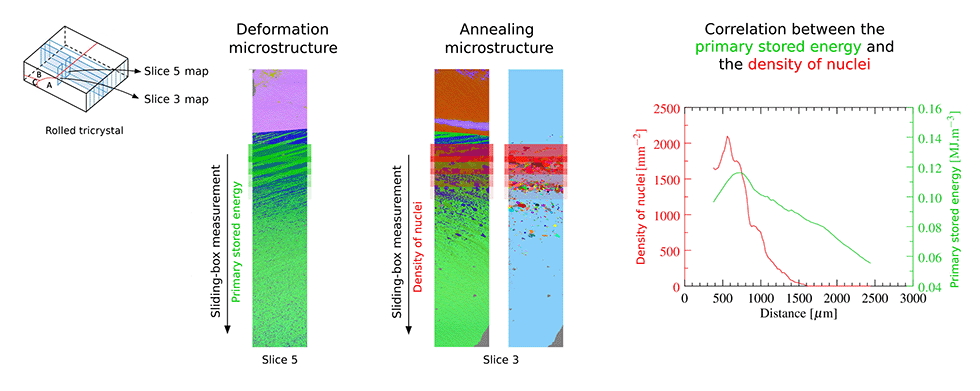
The evolution of polycrystalline microstructures during deformation processes (rolling, forging, etc.) is complex and has a significant impact on the material’s final mechanical properties. Optimizing microstructures requires a better understanding of the physical mechanisms involved during the different stages. We develop and utilize experimental, modeling/simulation, and theoretical methods to better understand and control microstructural evolutions:
The development of local characterization methods (HR-EBSD, X-ray diffraction in the laboratory and at synchrotrons) allows for the in situ or ex situ local analysis of microstructures and their evolution (crystalline orientations, dislocation densities, elastic deformations, etc.)
The development of microstructural evolution modeling and simulation methods allows for the prediction of microstructural evolutions during deformation. We develop both full-field approaches, such as crystal plasticity finite elements, particularly through the development of the Neper software (and FEPX), as well as mean-field approaches.
The analysis of microstructural evolutions associated with deformation, whether linked to crystal rotations induced by plasticity (deformation textures and microtextures) or to restoration and recrystallization phenomena (static and/or dynamic), improves the understanding of the mechanical and physical mechanisms at play locally, from which new concepts and models are developed that can be utilized in both academic and industrial settings.