
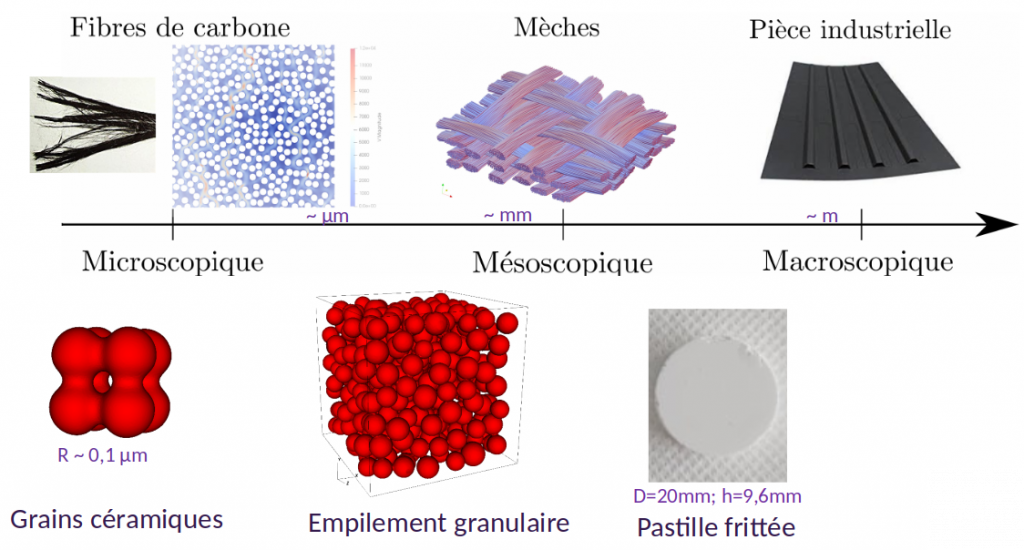
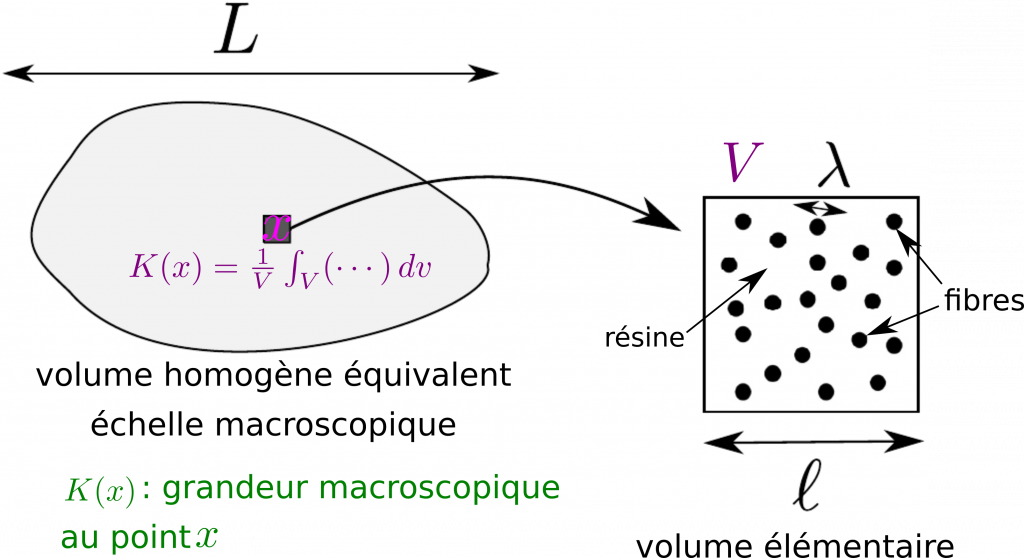
(Direct) manufacturing processes can be studied, characterized, modelled or simulated at different spatial (and also temporal) scales, characteristic of different physical phenomena: the macroscopic scale (the “process” scale), and meso- and/or microscopic scales depending on the nature of the material studied. The MPE team developed, notably between 2014 and 2019, experimental analysis and numerical simulation tools at the different scales mentioned, in the fields of composites as well as ceramics (PhD theses by L. Chevalier, K. Andriamananjara, A. Ducoulombier, I. Ghorbel). This research axis aims to couple these scales together. Below is an example of multiscale coupling in composites that accounts for microstructure variability using Gaussian processes (A. Geoffre’s PhD work, 2019–2022, Hexcel Chair).
- Context: homogenization by averaging over a representative elementary volume of a resin (epoxy) / fiber (carbon) composite material
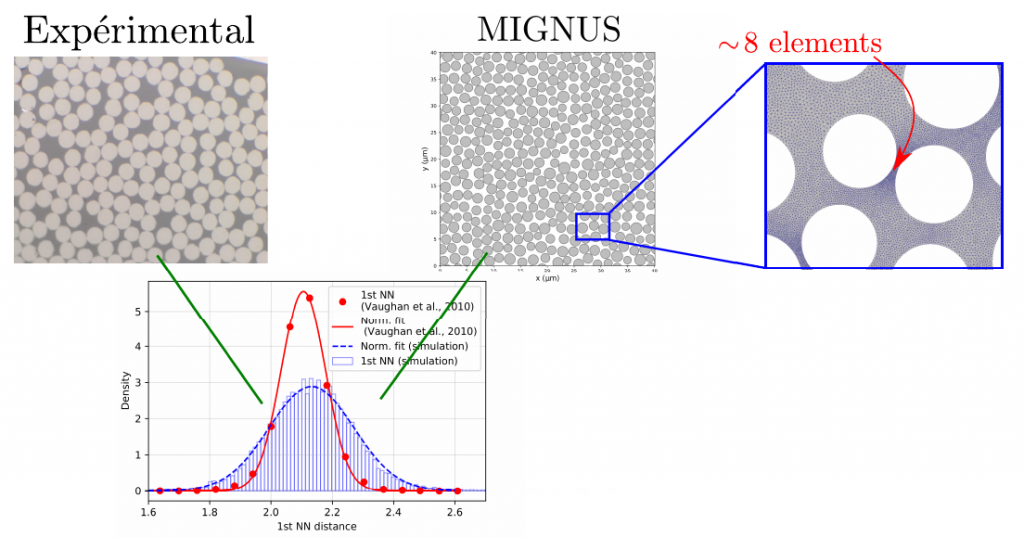
- Stochastic generation of an elementary volume statistically representative of the composite material (MIGNUS software, A. Geoffre, M. Cataldi, M. Ghestin)
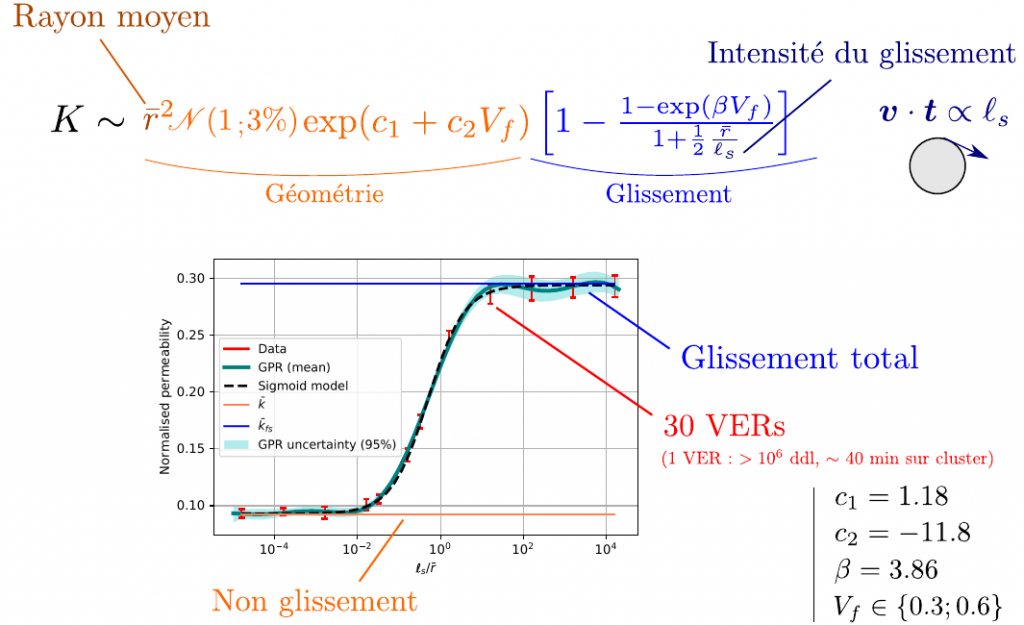
- Steady-state case
For many samples of elementary domains, solution of the Stokes equations using stabilized P1/P1 finite elements. Computation of permeability using Darcy’s law, for a given fiber/resin friction law. Gaussian process regression: quantification of permeability variability K [Geoffre et al., 2020]
- Unsteady-state case
For numerous samples of elementary domains, resolution of the bifluid air/resin Stokes equations by stabilized P1/P1 finite elements, including capillarity effects, and capture of the fluid front by a level-set method. Calculation of capillary pressure, saturation, and fluid front advancement, followed by Gaussian process regression.