The inauguration of the SIRA industrial chair (Intergranular Segregation and Fracture Properties of Low-Alloy Steels),…
PhD Defense – Clara Aydar – December 14, 2023
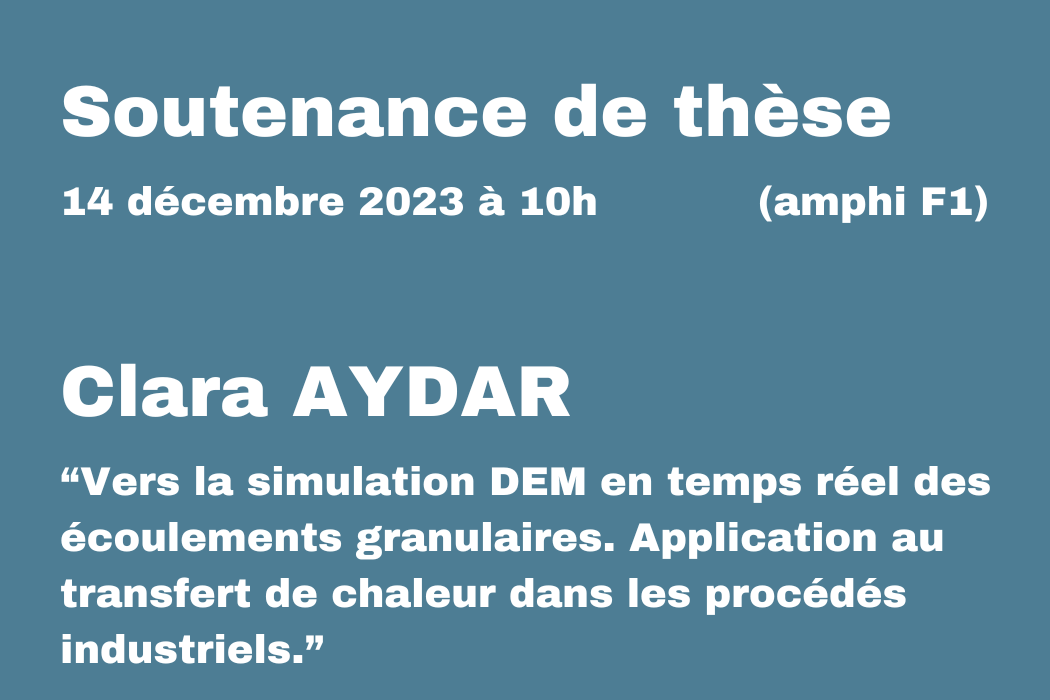
Clara Aydar will defend her thesis entitled “Towards Real-Time DEM Simulation of Granular Flows. Application to Heat Transfer in Industrial Processes” on December 14 at 10:00 AM in amphitheater F1 of the main building of École des Mines de Saint-Étienne (158 cours Fauriel 42100 Saint-Étienne).
Jury
Jean-Sébastien KROLL-RABOTIN, Associate Professor HDR, École des Mines de Nancy (Reviewer)
Thomas LICHTENEGGER, Associate Professor HDR, Johannes Kepler University Linz, Austria (Reviewer)
Nouria FATAH, Professor, École Centrale de Lille (Examiner)
Mohammed GUESSASMA, Professor, University of Picardie Jules Verne (Examiner)
Abibatou NDIAYE, PhD, Orano (Guest)
Olivier BONNEFOY, Professor, Mines Saint-Étienne (Thesis Director)
Sylvain MARTIN, Assistant Professor, Mines Saint-Étienne (Supervisor)
Abstract
Granular flows are present in numerous industrial and natural processes. To study these flows, we use the Discrete Element Method (DEM) which, despite computational advances, leads to simulations that are costly in terms of computation time.
In this context, we propose a new method aimed at significantly reducing computation time. The main idea is to extend an existing approach based on the pseudo-periodicity of processes. After a short DEM simulation (a few periods), the results are extrapolated to long times.
This approach enables the modeling of heat transfer in DEM simulations (without interstitial fluid) and CFD-DEM (with interstitial fluid). The extrapolation algorithm we have developed handles two types of heat transfer: conductive and convective. It can be extended to radiative transfer as well as to other transport phenomena such as the transport of chemical constituents.
We first validated our method by modeling a rotating drum to evaluate heat transfer by conduction. Next, we studied mixed conductive-convective heat transfer in a spouted bed. Our extrapolated results are in excellent agreement with the results of the standard simulation (error of less than 3%) and a drastic reduction in simulation time (factor of 100).
This work constitutes a first step toward low-cost numerical simulation of large-scale industrial processes. Our ultimate objective is to achieve a fast simulation method, applicable macroscopically, to study all types of reactive granular flows such as in rotary kilns, mixers, and fluidized beds.
Related Posts