David Piot, associate professor within the PMM team, will be the head of the French…
PhD Thesis Defense – Sarah Alzein – December 3, 2025
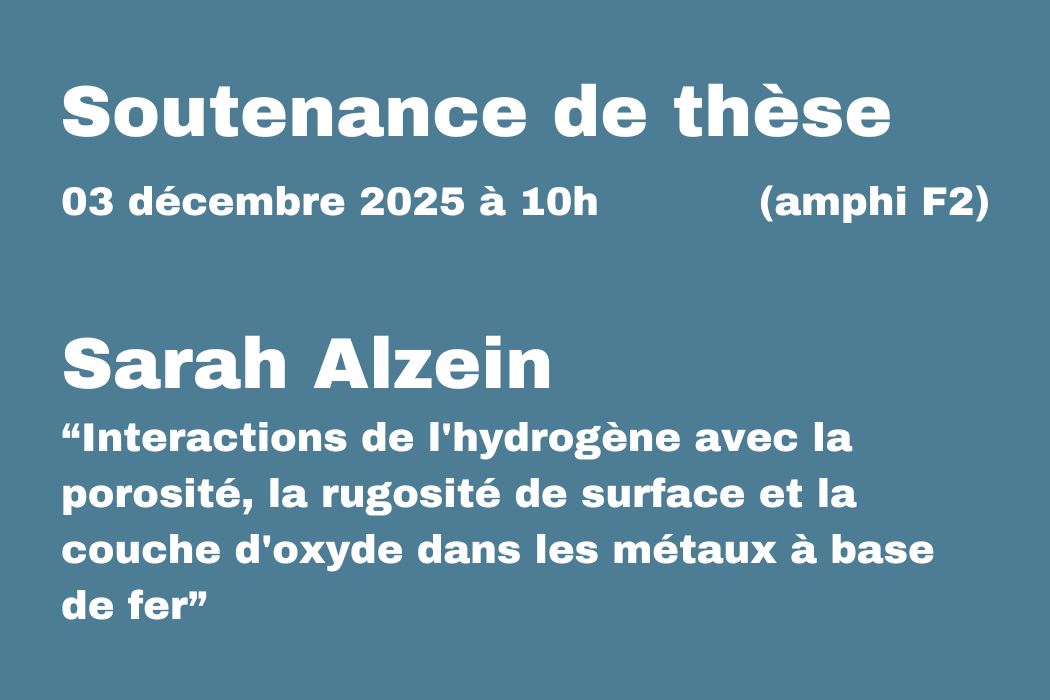
Sarah Alzein’s PhD thesis defense will take place on Wednesday, December 3, 2025, at 10:00 AM in amphitheater F2 at École des Mines de Saint-Étienne.
The thesis will be presented before a jury composed of:
- Jacques BESSON, Research Director, Mines Paris, CNRS, Examiner
- Jamaa BOUHATTATE, Associate Professor, University of La Rochelle, Examiner
- Emilio MARTINEZ-PAÑEDA, Associate Professor, University of Oxford, Reviewer
- Marc TUPIN, Research Director, CEA Saclay, Reviewer
- Frederic CHRISTIEN, Professor, Mines Saint-Étienne, Thesis Supervisor
- Alixe DREANO, Assistant Professor, Mines Saint-Étienne, Co-supervisor
- Vincent BARNIER, Research Engineer, Mines Saint-Étienne, CNRS, Guest
The defense will be followed by a reception.
Abstract
Hydrogen embrittlement is a major challenge for the reliability of metallic materials used in hydrogen infrastructure. While much work has focused on internal defects (dislocations, vacancies, grain boundaries), the effects related to porosity, surface roughness, and oxide layers remain largely unexplored. This thesis aims to fill this gap by studying the influence of these often-overlooked characteristics on hydrogen absorption, diffusion, and trapping in pure iron and Fe–Cr alloys.
To this end, an integrated experimental and numerical approach was developed, combining electrochemical permeation (EP), thermal desorption spectroscopy (TDS), microscopy (SEM, AFM, FIB, EBSD, TKD), and surface analysis (XPS, AR-XPS) techniques, supported by non-equilibrium thermodynamic models.
The results show that: (i) microporosities act as reversible traps responsible for atypical diffusion behavior (“double rise” in permeation curves); (ii) surface roughness limits hydrogen entry through increased recombination, but promotes its retention by mechanically induced subsurface defects; (iii) oxide layers evolve under the effect of hydrogen, with iron oxide selectively reducing while chromium oxide stabilizes the passive layer.
These results provide a broader understanding of embrittlement mechanisms by integrating surface and bulk contributions. They open up perspectives for the design of materials more resistant to hydrogen environments and for the development of protection strategies adapted to hydrogen economy infrastructures.
Keywords
Hydrogen; diffusion and trapping; porosity; roughness; oxide
Related Posts