David Piot, associate professor within the PMM team, will be the head of the French…
A microstructural characterization study in the service of asteroid impact history
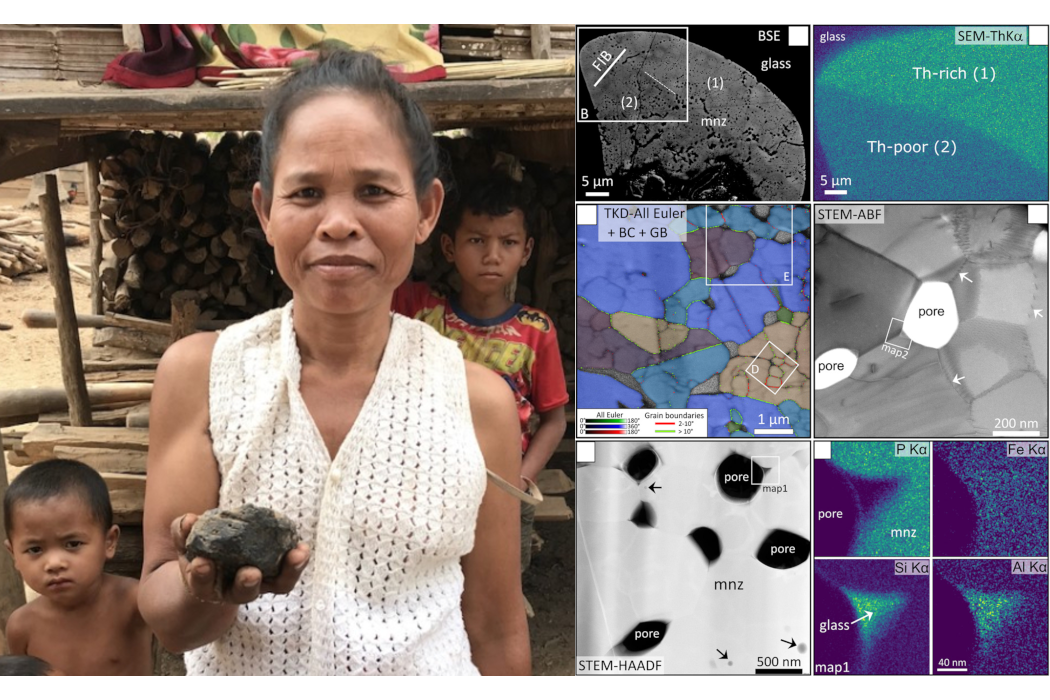
Approximately eight hundred thousand years ago, an asteroid impacted the Earth, devastating the Indochinese Peninsula and ejecting droplets from the melting of the Earth’s surface (tektites, known as australasites) as far as Australia and Antarctica. These tektites have been known since Darwin, but the crater has not yet been found. As part of a collaboration involving the Laboratoire de Géologie de Lyon: Terre, Planètes, Environnement (LGL-TPE – OSUL), the Centre Européen de Recherche et d’Enseignement de Géosciences de l’Environnement (CEREGE – OSU Pythéas), the Laboratoire Magmas et Volcans (LMV – OPGC), the Laboratoire Géosciences Environnement Toulouse (GET – OMP), all affiliated with the Institut National des Sciences de l’Univers (INSU), and the Georges Friedel Laboratory (affiliated with the CNRS Ingénierie institute), a nano-scale study of a 50-micron monazite grain (rare earth phosphate), recovered from a large layered tektite from Thailand, has provided major clues for locating this crater.
To learn more, find this news on the INSU website: https://www.insu.cnrs.fr/fr/cnrsinfo/la-recherche-du-cratere-perdu-des-australasites-letude-dune-monazite
Related Posts