The Holy Grail for any mechanical engineer is to be able to use a material…
Correlative image learning of chemo-mechanics in phase-transforming solids
Learning the constitutive laws of solids could lead to advancements in energy, electronics, and many other scientific and engineering applications. For a single-phase, homogeneous material, constitutive relations involving composition are straightforward to characterize. However, learning such laws for materials that are heterogeneous at the nanoscale is substantially more difficult. For example, despite more than two decades of progress, two fundamental questions remain regarding the currently used battery positive electrode material LiXFePO4: (a) what is the extent of the elastic coherency domain and plastic deformation at phase boundaries, and (b) how does the metastable solid solution expand and contract within the miscibility gap?
Using X-ray spectro-ptychography and four-dimensional scanning transmission electron microscopy (STEM), the local Li composition and lattice strain in thick LiXFePO4 particles were identified using an image-learning framework employing physical constraints and regularization (Fig. 1). A mostly linear Li concentration–eigenstrain relationship across the entire composition range (for X = 0.05–0.95) was identified, experimentally validating Vegard’s law at the nanoscale.
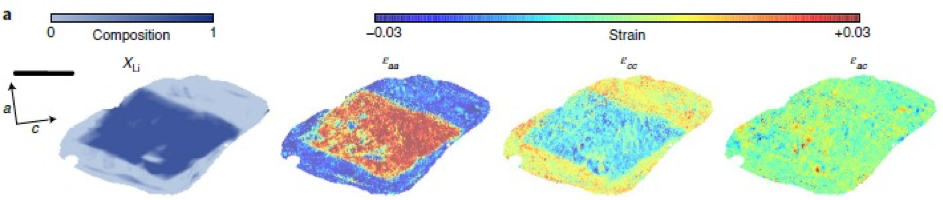
The lattice strain maps show “hot spots” located around the phase boundaries and within the phase-separated regions, indicating the presence of dislocations. Analysis of X-ray diffraction peak profiles confirmed the presence of dislocations and made it possible to determine their Burgers and line vectors.
Related Posts