Julien Favre has obtained ANR project funding on the general theme of additive manufacturing. This…
The superpowers of Al2O3/Al nanolaminate coatings
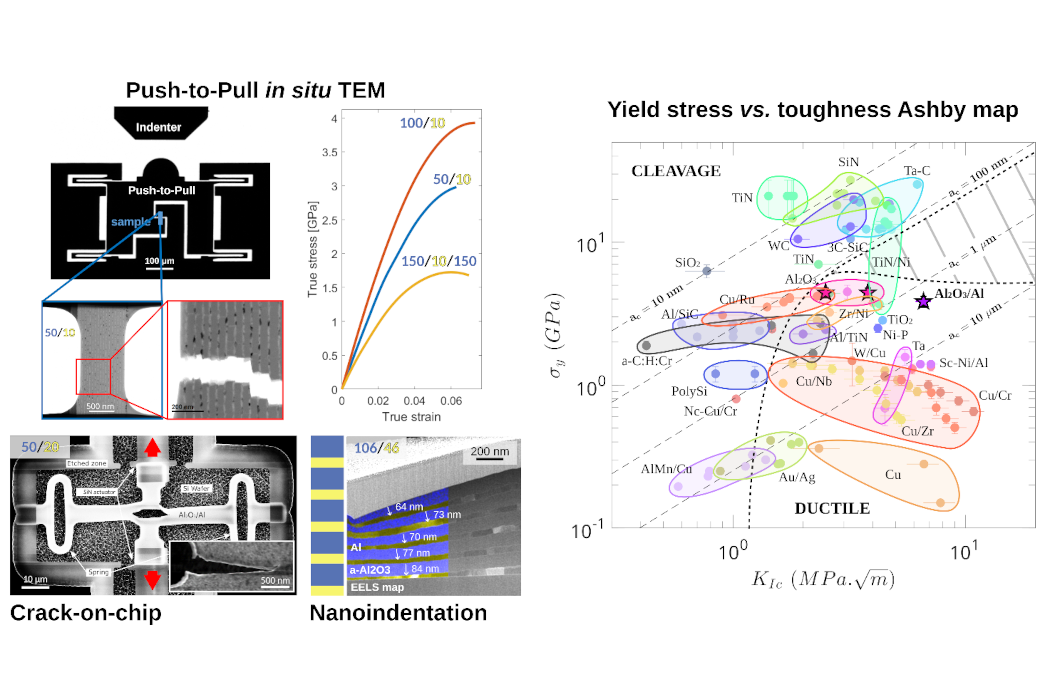
The Holy Grail for any mechanical engineer is to be able to use a material possessing high hardness, a good capacity to deform without breaking, and good crack resistance. However, these three properties are conflicting for most materials. A team from UCLouvain and the WEL Research Institute, in collaboration with the universities of Namur and Antwerp, has developed a new type of coating with exceptional mechanical properties: a nanolaminate that alternates thin layers of amorphous alumina Al2O3, typically 100 nm thick, with even thinner layers of aluminum. Paul Baral and Morgan Rusinowicz, two associate professors at the Georges Friedel Laboratory UMR5307 Mines Saint-Etienne / CNRS Engineering, participated in this extraordinary adventure.
The invention of this material, produced by physical vapor deposition, is based on the principle that amorphous Al2O3 is ductile at a thickness of less than approximately 100 nm. To obtain a thicker, useful coating, it was therefore necessary to stack these very thin layers using the appropriate adhesive. This adhesive is provided by aluminum, creating very strong interfaces with the alumina, while also providing energy dissipation capacity and the ability to stop cracks that may appear in the Al2O3. The result is a thin coating (thinner than a micrometer) with the highest combined levels of strength, measuring the material’s hardness; ductility, measuring the ability to deform without breaking; and toughness, measuring the ability to resist cracking in the presence of defects. This nanolaminate has a yield strength on the order of 4 GPa, equivalent to metal oxides, while maintaining a toughness of 6.6 MPa.m1/2, comparable to that of thin-film copper. In addition, this material benefits from the excellent corrosion resistance of alumina. The major challenge of this research was to accurately determine the intrinsic properties of this coating and its individual layers, and then link them to the physical mechanisms governing these excellent properties. To achieve this, the team used UCLouvain’s patented nanomechanical on-chip testing approach based on microelectronic fabrication methods, tensile testing, characterization in a transmission electron microscope, nanoindentation, and finite element modeling. The potential applications are numerous, particularly in technologies involving harsh environments that combine corrosion, erosion, wear, and mechanical shock. This work is published in the journal Nature Communications.
Related Posts