An LGF seminar will take place on Friday, October 9, 2026 at 2:00 PM in…
LGF Seminar – Giovanni Bonny (SCK CEN, Belgium) – January 22, 2024
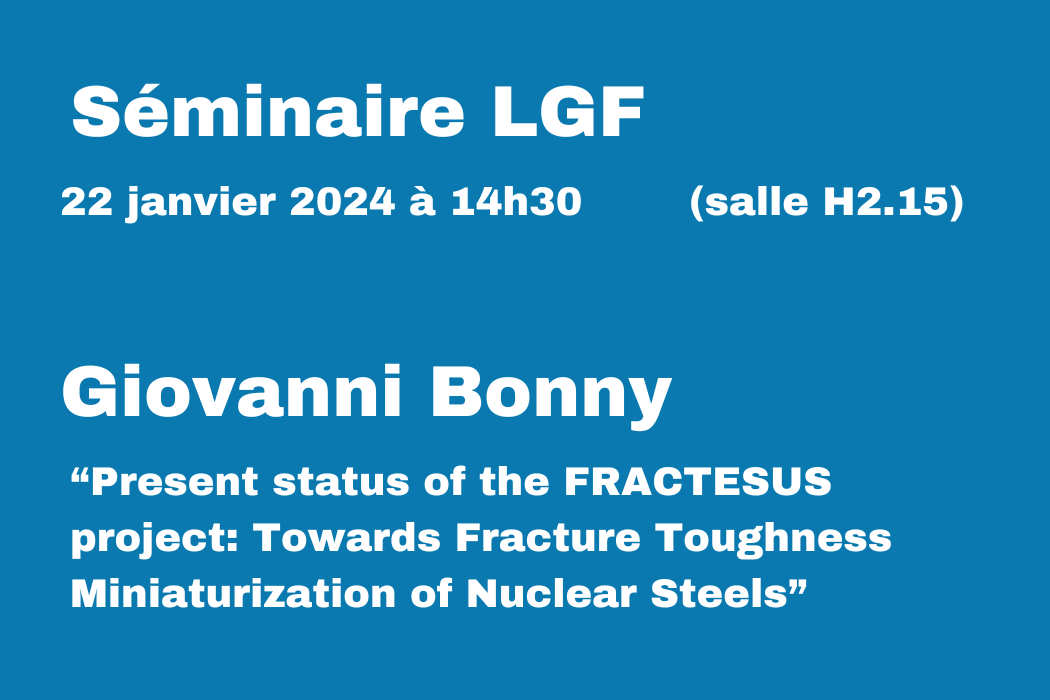
Giovanni Bonny (SCK CEN, Belgium) will deliver the following seminar.
Title
Current status of the FRACTESUS project: Towards miniaturizing fracture toughness testing of nuclear steels
Abstract
The fracture toughness of a material characterizes its resistance to crack propagation and is an important design parameter to ensure the structural integrity of components. From several fracture toughness experiments within the ductile-to-brittle transition zone, the reference temperature, T0, can be derived by applying the Master Curve approach. Here, T0 defines the transition temperature for a median fracture toughness of 100 MPa·√m for a 1-inch fracture toughness specimen. It is important to note that a shift in T0 denotes a shift in transition temperature. For example, in the context of irradiation embrittlement of steels, the shift in T0 provides a measure of the shift in ductile-to-brittle transition temperature (DBTT).
To assess irradiation embrittlement of reactor pressure vessel (RPV) steels, nuclear regulatory bodies base their evaluation primarily on the semi-empirical methodology based on impact tests on Charpy surveillance specimens. In the context of long-term operation (LTO) of current nuclear power plants, surveillance data are scarce, and irradiation space in materials test reactors (MTR) is limited and costly. In addition, the miniaturized size of the specimens limits their activity, which facilitates their handling. Therefore, determining irradiation embrittlement on miniaturized specimens is desirable.
Applying the Master Curve approach makes it possible to determine T0 and thus the shift in T0 from different specimen sizes and geometries at different test temperatures. As such, miniature compact tension (MCT) specimens can be used to optimize irradiation space in MTR; alternatively, MCT specimens can be extracted from broken Charpy surveillance specimens. The latter can provide valuable additional data for the plant’s safety case.
The FRACTESUS project aims to determine the effect of specimen size on fracture toughness properties. Finite element models (FEM) are used to investigate the difference between large-size and miniature compact tension (MC(T)) specimens and to quantitatively assess the resulting loss of constraint due to size reduction. The optimal range of usability of MC(T) specimens can therefore be determined and demonstrated with experimental results. Extensive inter-laboratory testing is included in the FRACTESUS project in an attempt to demonstrate the repeatability and reproducibility of small-scale fracture toughness testing. Various materials relevant to most available reactor pressure vessel materials and irradiation conditions are investigated.
This contribution provides an overview of the project’s current status and achievements to date, presenting both experimental and FEM results.
Related Posts