An LGF seminar will take place on Friday, October 9, 2026 at 2:00 PM in…
LGF Seminar – Thomas Lichtenegger (Johannes Kepler University Linz, Austria) – December 13, 2023
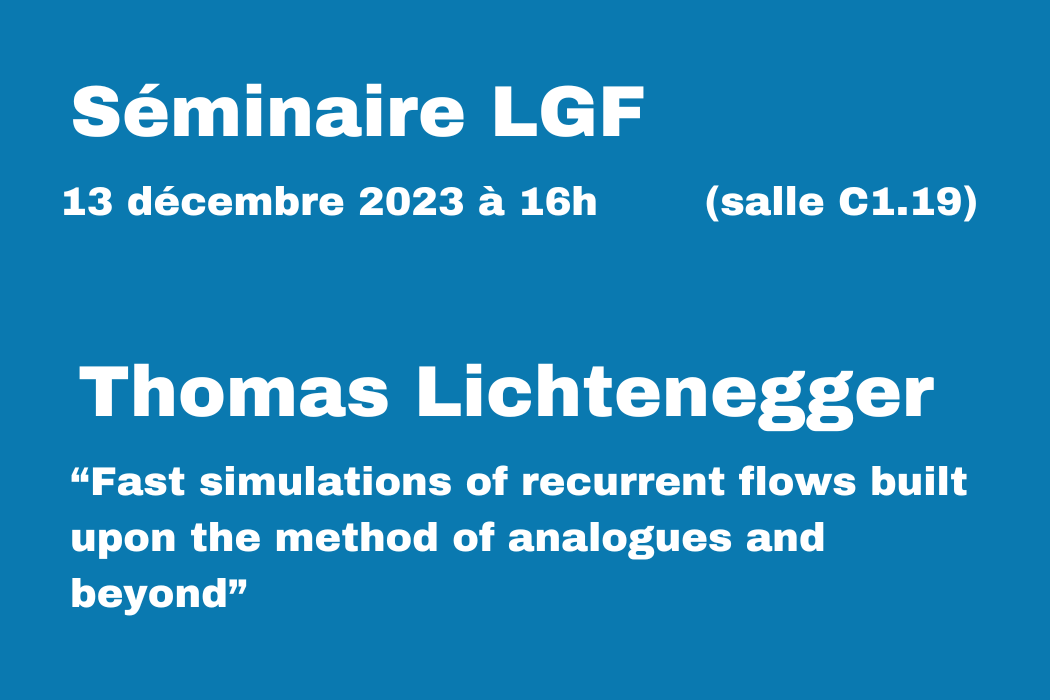
Thomas Lichtenegger (Johannes Kepler University Linz, Austria) is visiting our laboratory. On this occasion, he will give the following seminar.
Title
Fast simulations of recurrent flows built upon the method of analogues and beyond
Abstract
Various dynamic flows such as bubble columns or fluidized particle beds are characterized by recurring patterns, i.e. flow structures that reappear either in an approximately periodic or in a completely irregular fashion. Using a prerecorded database of flow field time series and a corresponding recurrence plot, one can iteratively predict the behavior of such a system at little numerical cost by assuming that sufficiently similar states evolve almost identically for a short duration. On top of such a time-extrapolated series of flow fields, passive or weakly coupled processes like species or heat transport and transfer between phases can be simulated with speedups of more than two orders of magnitude compared to the underlying CFD-DEM simulations. This opens the door to investigating temporal multiscale problems over long process durations, e.g. slow heat transfer or chemical conversion on highly dynamic backgrounds.
Future developments will take into account the deviation between a state for which a forecast is made and its nearest neighbor in the database so that transient problems evolving away from the database can be described systematically. Ultimately, this kind of data-assisted simulation might be sufficiently fast and flexible to create virtual twins of industrial processes to optimize or control them.
Biography
Thomas Lichtenegger studied Technical Physics at Johannes Kepler University (JKU), Linz, Austria, and earned his PhD in many-body quantum physics in 2013. After continuing his research as a postdoctoral researcher at the University at Buffalo, New York, he joined the Department of Particulate Flow Modelling at JKU as a Senior Scientist and shifted his focus to computational physics and engineering of granular multiphase flows. He is particularly interested in data-assisted high-performance methods for temporal multiscale problems found in fluidized and moving bed reactors.
Related Posts