David Piot, associate professor within the PMM team, will be the head of the French…
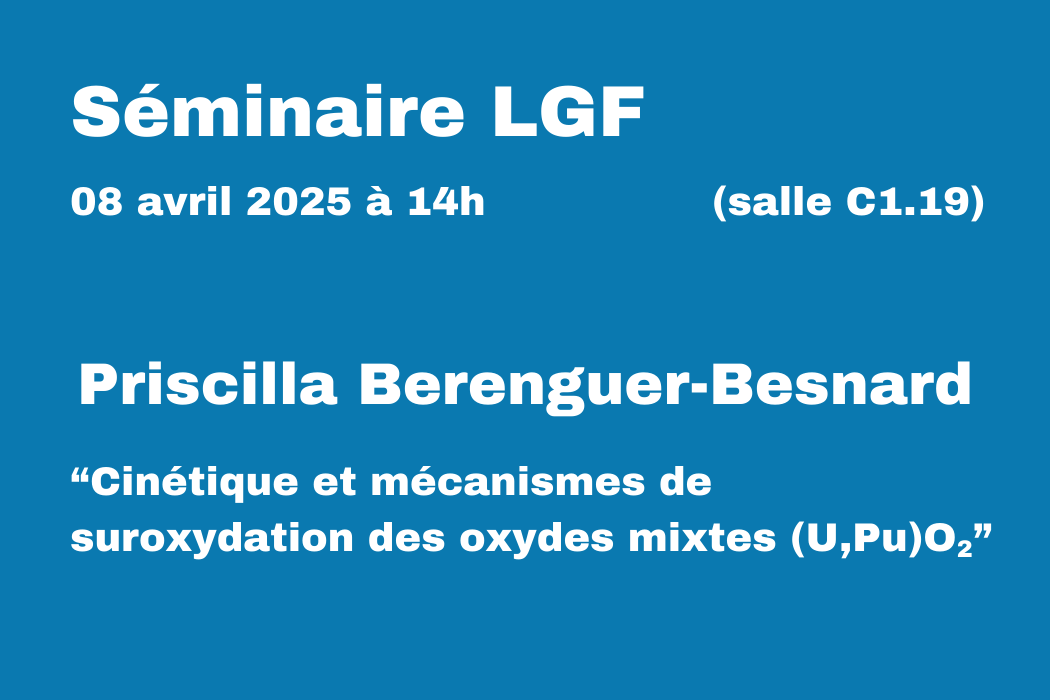
LGF Seminar – Priscilla Berenguer-Besnard – April 14, 2025
Title
Kinetics and Mechanisms of Overoxidation of Mixed Oxides (U,Pu)O2
Abstract
Multi-recycling of plutonium in Pressurized Water Reactors is an option currently being studied in France, which would stabilize the plutonium inventory. This strategy requires the development of innovative processes to enable the reprocessing of spent MOX fuel (mixed uranium and plutonium oxide) at industrial rates. One of the solutions under consideration involves an oxidizing heat treatment, which would extract the spent fuel from its cladding prior to dissolution to increase its reactivity in contact with nitric acid. The idea is to take advantage of the phase transitions resulting from oxidation to cause the fuel to collapse into powder. However, the distribution of plutonium within the microstructure of current MOX fuels is heterogeneous. Understanding the oxidation behavior of these fuels therefore requires understanding that of the main “pseudo-phases” that constitute them.
To this end, the approach adopted in this thesis consisted of studying the oxidation of four model compounds (MC) U1-yPuyO2 incorporating different Pu contents (y = 0; 0.11; 0.27 and 0.44), representative of the “pseudo-phases” of a MOX fuel. The objectives of this work were in particular to study the effect of Pu content, temperature and oxygen partial pressure (pO2) on the nature of the hyperoxides formed, their formation kinetics, as well as the associated mechanisms.
The oxidation of UO2 to U3O8 was studied via thermogravimetric experiments on powders and on sintered samples. The kinetic curves obtained under isothermal (350°C – 600°C) and isobaric (20 kPa ≤ pO2 ≤ 71 kPa) conditions, as well as the so-called “inert marker” experiment, made it possible to propose an oxidation mechanism of UO2 to U3O8. A kinetic model, capable of satisfactorily reproducing the experimental data, was also proposed based on this mechanism. The formation of the intermediate oxide U3O7 during the oxidation of UO2 to U3O8 was also demonstrated in certain experiments.
Monitoring the oxidation kinetics of (U,Pu)O2 compounds under isothermal (350°C or 500°C) and isobaric (pO2 = 20 kPa or 80 kPa) conditions showed that an increase in temperature increases the oxidation kinetics, while an increase in pO2 has little or no effect on the kinetics or the O/M ratio reached after oxidation. The nature of the hyperoxides formed during the oxidation of (U,Pu)O2 compounds depends on their plutonium content.
The results showed that the solubility limit of Pu in the U3O8 phase is close to 11%. Thus, the oxidation of the compound with 11% Pu, at 500°C and pO2 = 20 kPa, leads to the formation of an almost pure (U,Pu)3O8 phase, while for the MC with 27% and 44% Pu, this mainly leads to the formation of (U,Pu)3O7 and (U,Pu)4O9 phases.
Related Posts