David Piot, associate professor within the PMM team, will be the head of the French…
PhD Defense – Gianluca Vernassa – November 26, 2025
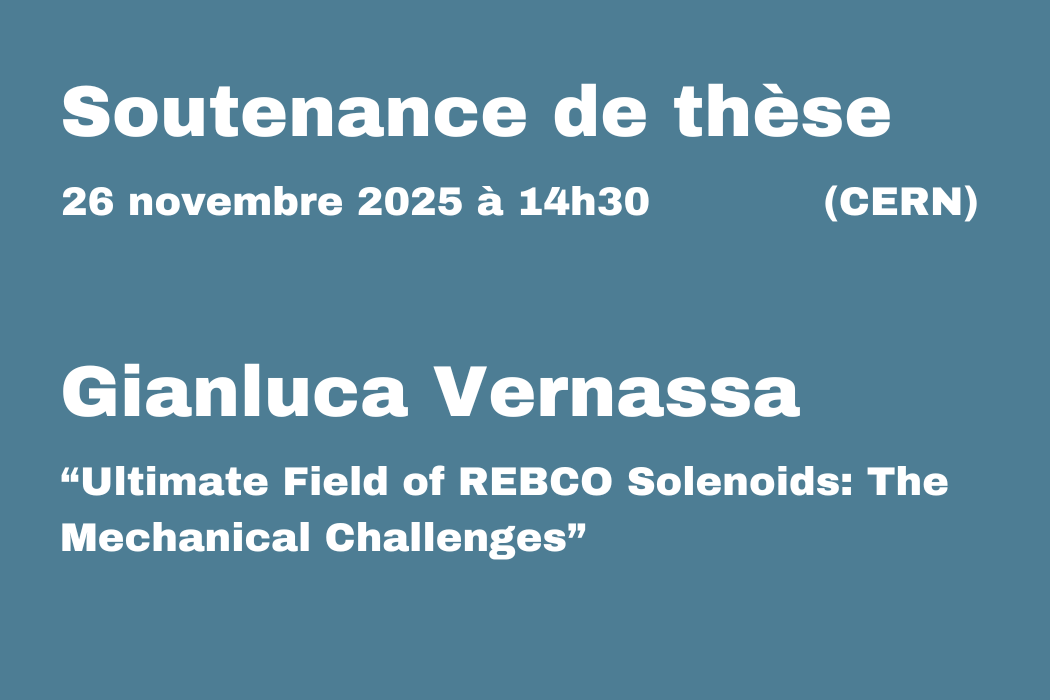
The PhD defense of Gianluca Vernassa will take place on Wednesday, November 26, 2025 at 2:30 PM at CERN, BE Auditorium 774/R-013. You can follow the defense via ZOOM.
The thesis will be presented before a jury composed of:
- CHIESA Luisa, Professor, Tufts University
- HAHN Seungyong, Professor, Seoul National University
- AWAJI Satoshi, Professor, Tohoku National University
- TIXADOR Pascal, Professor, Université Grenoble Alpes
- KERMOUCHE Guillaume, Professor, Mines Saint-Etienne
- BERGHEAU Jean-Michel, Professor, Ecole Centrale de Lyon
- BOTTURA Luca, Doctor, CERN
- FELICE Hélène, Doctor, CEA
- BORDINI Bernardo, Doctor, CERN
- LAVERNHE Karine, Associate Professor, Laboratoire de Mécanique Paris-Saclay
Abstract
The need for strong, steady-state magnetic fields of 40 T and above raises significant challenges in the design of superconducting magnets. Rare-earth barium copper oxide (REBCO) coated conductors are today the most promising candidates for such applications. However, the layered architecture of these materials entails major mechanical challenges. Recent tests of ultra-high field (UHF) REBCO magnets have demonstrated their capability to operate at fields up to 48.7 T, while also revealing crucial issues of this magnet technology related to the management of the loads that develop in ultra-high fields.
This thesis proposes to address these challenges with a comprehensive structural mechanics perspective, building on the experimental evidence gathered from tested magnets, and tracing back the primary causes through a multiscale approach. This research work is founded on experimental and modelling efforts, developed synergistically at the conductor’s scale. These are subsequently extended to the magnet level to highlight how conductor properties dictate mechanical design strategies. The research establishes the basis for the construction of future, more resilient ultra-high field solenoids.
Related Posts