David Piot, associate professor within the PMM team, will be the head of the French…
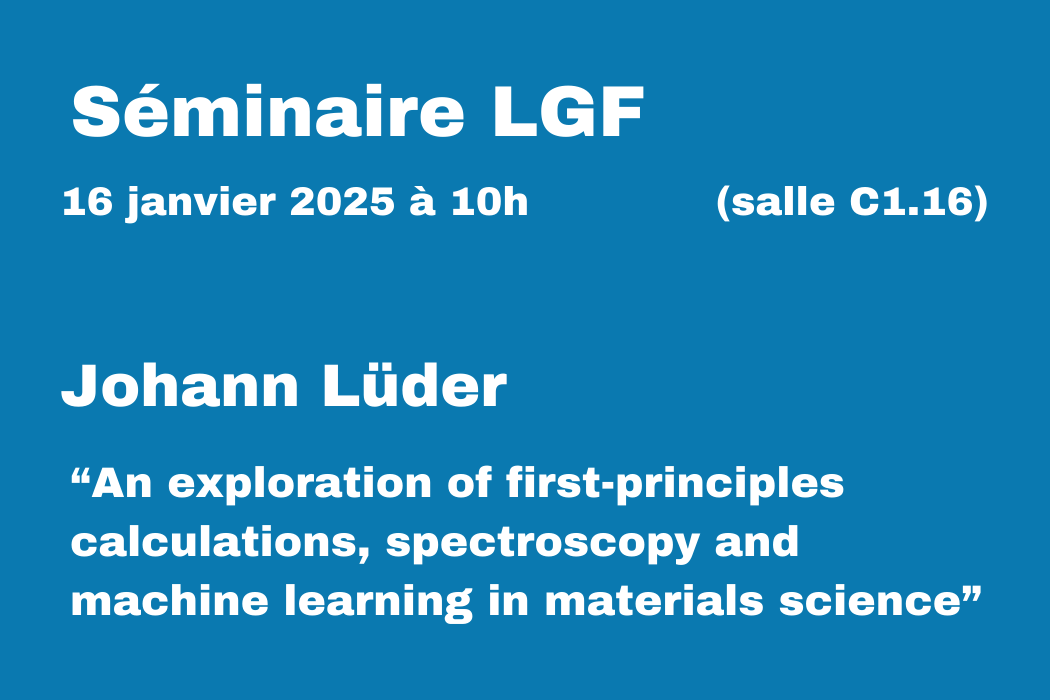
LGF Seminar – Johann Lüder (NSYSU, Taiwan) – January 16, 2025
Title
An exploration of first-principles calculations, spectroscopy, and machine learning in materials science
Abstract
Materials research is at the frontier of technological innovations urgently needed to address many challenges faced by modern societies, from the exponential increase in transmitted, stored, and processed data to environmental pollution, sustainable resource management, and clean energy generation, storage, and transfer. Many fundamental questions and potential solutions are now accessible and made possible through computational materials research, contributing, for instance, to improved catalyst design for the hydrogen economy, decarbonization, and photocatalytic fuel generation. This talk will present our recent computational studies and developments at the interface of materials science, machine-learning techniques, and first-principles calculations, as well as contributions to experimental studies. We will introduce our neural-network-based development for X-ray absorption spectroscopy at the L-edge and outline recent developments in orbital-free density functional theory that apply high-throughput database generation and a machine-learned kinetic energy functional. Furthermore, we will introduce cheminformatics concepts and the potential of computationally guided molecular design for clean energy devices, including batteries and solar cells, as well as calculations of catalytic processes on metal and semiconductor surfaces.
Bio
Dr. Johann Lüder is an associate professor in the Department of Materials and Optoelectronic Science and an executive member of the Center for Theoretical and Computational Physics at National Sun Yat-Sen University (NSYSU) in Kaohsiung, where he began building his computational research group in 2018. In 2016, he joined the National University of Singapore for a two-year research fellowship in the Department of Mechanical Engineering after completing his PhD studies in Atomic, Molecular, and Condensed Matter Physics at Uppsala University in Sweden. He obtained his B.Sc. degree from Free University Berlin, Germany, and his M.Sc. degree from Uppsala University.
He develops machine learning approaches to advance computational materials science methods, including theoretical X-ray spectroscopy simulations and first-principles methods such as density functional theory (DFT) and orbital-free DFT, paving the way for seamless first-principles calculations to explore phenomena spanning the atomic and mesoscale. His computational lab applies these methods and combines them with high-throughput and data science techniques to derive a fundamental understanding of materials’ properties at the atomic scale. The computational results can elucidate questions in sensor development, catalysis, and clean energy conversion and storage, providing insights into the design of more durable and better-performing devices.
Related Posts