David Piot, associate professor within the PMM team, will be the head of the French…
PhD Thesis Defense – Maxime Lematais – January 13, 2025
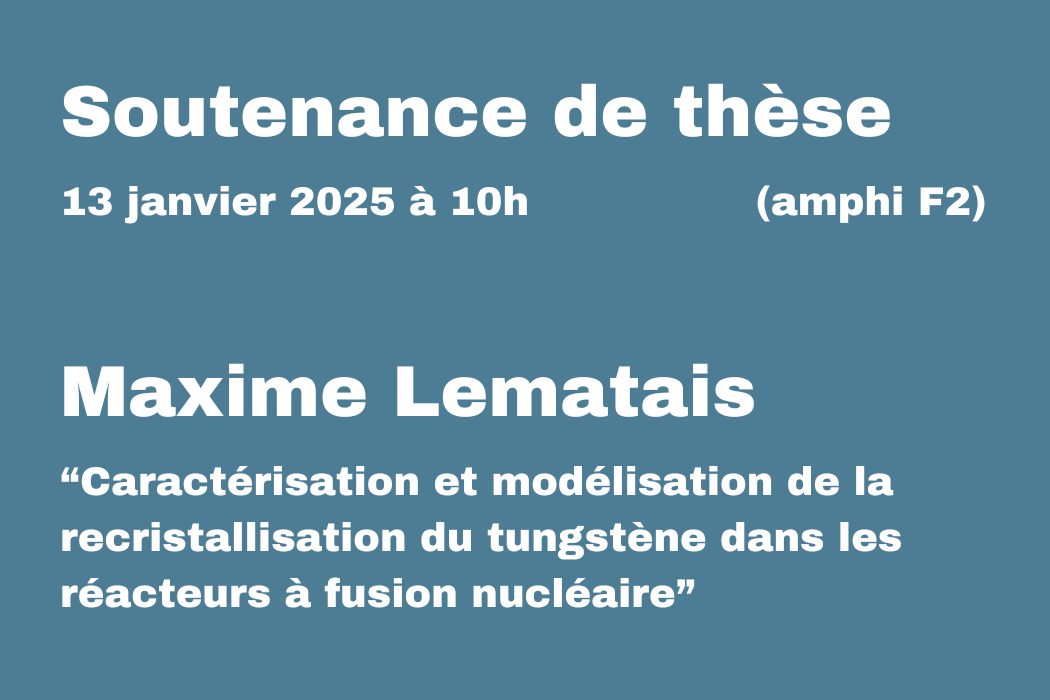
The PhD thesis defense of Maxime Lematais will take place on Monday, January 13, 2025, at 9:55 AM in amphitheater F2 of the École des Mines de Saint-Étienne.
It will also be possible to attend the defense online via Zoom.
The work will be presented before a jury composed of:
- Sophie Cazottes, Associate Professor (HDR), INSA Lyon, Reviewer
- Dominique Vrel, CNRS Research Director, Institut Galilée, Reviewer
- Marie-France Barthe, CNRS Research Director, University of Orléans, Examiner
- Takeshi Hirai, PhD, ITER, Examiner
- Guillaume Kermouche, Professor, Mines Saint-Étienne, Thesis Director
- Laurent Gallais, Professor, Institut Fresnel, Thesis Co-director
- Marianne Richou, PhD, CEA, Supervisor
- Claire Maurice, CNRS Research Fellow, Mines Saint-Étienne, Supervisor
The defense will be followed by the traditional thesis reception, to which participants are cordially invited.
Abstract
Fusion is an exothermic nuclear reaction envisioned for electricity production. In nuclear fusion reactors, the fuel is heated to around 150 million degrees Celsius to initiate the fusion reaction. Charged particles escaping from the fusion plasma are transported to a region called the divertor. In this region, divertor components must withstand intense ionic and thermal fluxes. On these components, tungsten is the primary material exposed to the plasma. Consequently, it is subjected to temperatures ranging from 300 to 3,400 °C. The recrystallization of tungsten is a microstructural transformation that occurs when it is subjected to temperatures exceeding 1,000 °C. This transformation is accompanied by a modification of the properties of tungsten, thereby affecting the performance of divertor components. Each factor (initial microstructure, temperature, plasma exposure) affecting recrystallization has been studied independently by various authors. Although tungsten recrystallization has been a known phenomenon for over 50 years, its study in a nuclear fusion environment remains complex. To determine the coupled effect of these factors on recrystallization, it is necessary to reproduce the conditions expected in a tokamak through simulations or experiments. The expected ionic, neutron, and thermal fluxes vary significantly from one component to another depending on its position in the divertor. The temperatures and irradiation conditions resulting from these thermal fluxes also fluctuate greatly within a single component. The diversity of these conditions, coupled with the mosaic of tungsten materials developed for nuclear fusion reactors, results in a very large number of possible combinations. The coupled study of factors affecting recrystallization therefore requires numerous experiments or numerical simulations. The objective of this thesis is to develop new methods to reduce the duration of experiments and simulations used to study tungsten recrystallization at high temperatures. To this end, experimentation, characterization, and modeling methods have been developed. High-temperature heat treatment experiments to accelerate tungsten recrystallization were first developed. These experiments allow for a reduction of several orders of magnitude in the time required to reproduce the temperature conditions responsible for tungsten recrystallization during slow transients. Subsequently, a methodology to optimize the post-processing of EBSD maps is proposed. This methodology allows for the discrimination between recrystallized and non-recrystallized grains. A method is also proposed to accelerate the estimation of dislocation density in non-recrystallized grains. These methods are used to study the recrystallization of a material meeting ITER specifications. The influence of pre-exposure to a helium plasma, temperature ramps, and thermal gradients on the recrystallization of this material is measured. Finally, the different mechanisms responsible for recrystallization are studied separately using XRD, EBSD analyses, and hardness tests. Based on the results of this study, a JMAK model is developed to correlate grain growth, the decrease in dislocation density, and the evolution of the recrystallized fraction.
Keywords: recrystallization, tungsten, nuclear fusion, laser process, heat treatment, EBSD, XRD, hardness, microstructure.
Related Posts