David Piot, associate professor within the PMM team, will be the head of the French…
PhD thesis defense – Bastien Le Porcher – October 20, 2025
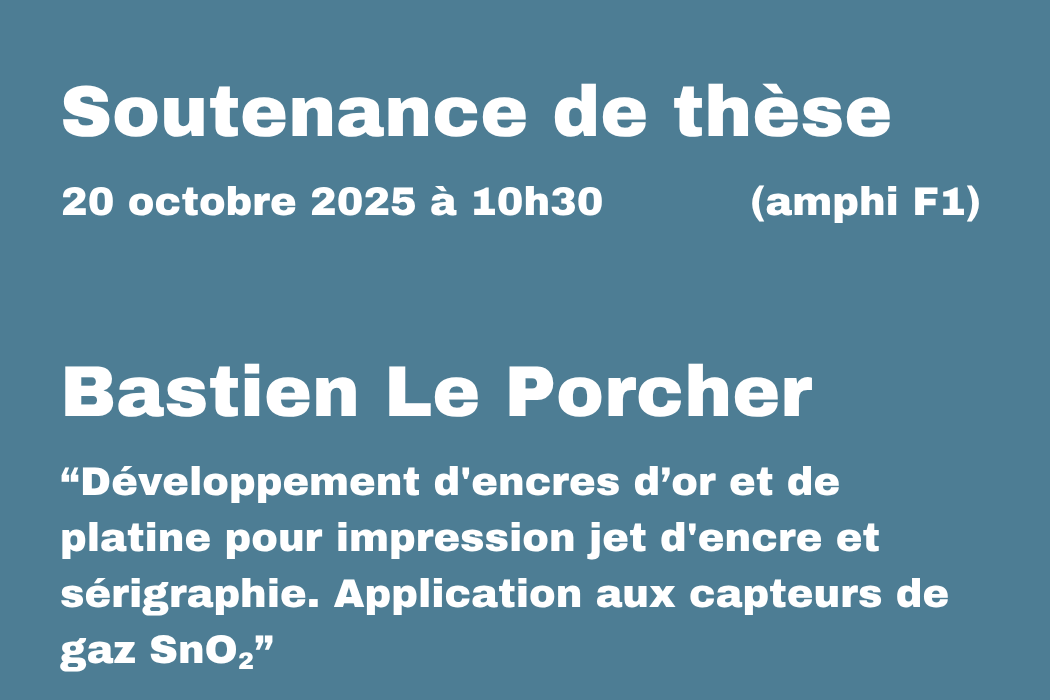
Bastien Le Porcher’s PhD thesis defense will take place on Monday, October 20, 2025 at 10:30 AM in the F1 lecture hall at École des Mines de Saint-Étienne.
The thesis will be presented before a jury composed of:
- Hélène DEBEDA, Professor (HDR), University of Bordeaux (Examiner)
- Benoît PIRO, Professor (HDR), Université de Paris Cité (Reviewer)
- Jean-Baptiste SANCHEZ, Professor (HDR), University of Besançon (Reviewer)
- Mathilde RIEU, Research Officer, Mines Saint-Étienne (Thesis Supervisor)
- Jean-Paul VIRICELLE, Research Director, Mines Saint-Étienne (Thesis Supervisor)
The defense will be followed by a reception.
Abstract:
Gas sensors are now essential for detecting flammable, toxic, or polluting gases. Many gas detection devices have been developed; one of the most widely studied is the semiconducting metal-oxide-based sensor, notably based on SnO2. These sensors consist of a SnO2 sensing element, conductive gold electrodes, and a platinum resistor, required to reach operating temperatures of around 350°C. Although the ink used to print the sensing element is developed in our laboratory, the electrodes and heating elements had until now been manufactured using commercial metal inks. Commercial inks are expensive, may present batch-to-batch reproducibility issues, and have unknown compositions, which can impair or modify the sensors’ gas responses due to the presence of fluxes and metal oxides. To address these issues, gold and platinum inks were formulated for sensor fabrication. For inkjet printing, gold and platinum inks based on suspended nanoparticles or on precursors solubilized in solution were developed. Gold nanoparticles are synthesized using a Turkevich method optimized for our application, while platinum nanoparticles are synthesized via the polyol route. These nanoparticles in solution are mixed with solvents such as glycerol, ethylene glycol, water, or propan-2-ol to obtain inks. After optimizing deposition parameters on polyimide and the thermal treatment, electrodes are obtained. This sensor, printed with our inks on a flexible substrate, was exposed to gases—CO and NO2—and shows responses similar to a sensor printed with commercial inks. For screen printing, gold and platinum powders were synthesized by reducing the precursors with ascorbic acid. The syntheses were optimized to obtain particles with a diameter of about 1 micron so that they can pass through the mesh of screen-printing stencils. These powders, mixed with terpineol and ethylcellulose, make it possible to obtain screen-printing inks for printing electrodes and the heating element. Manufacturing a complete sensor with our inks yielded gas responses similar to those of a reference sensor printed with commercial inks, demonstrating the feasibility of our sensors.
Related Posts