
David Piot, associate professor within the PMM team, will be the head of the French…
PhD thesis defense – Léo Théodon – November 25, 2024
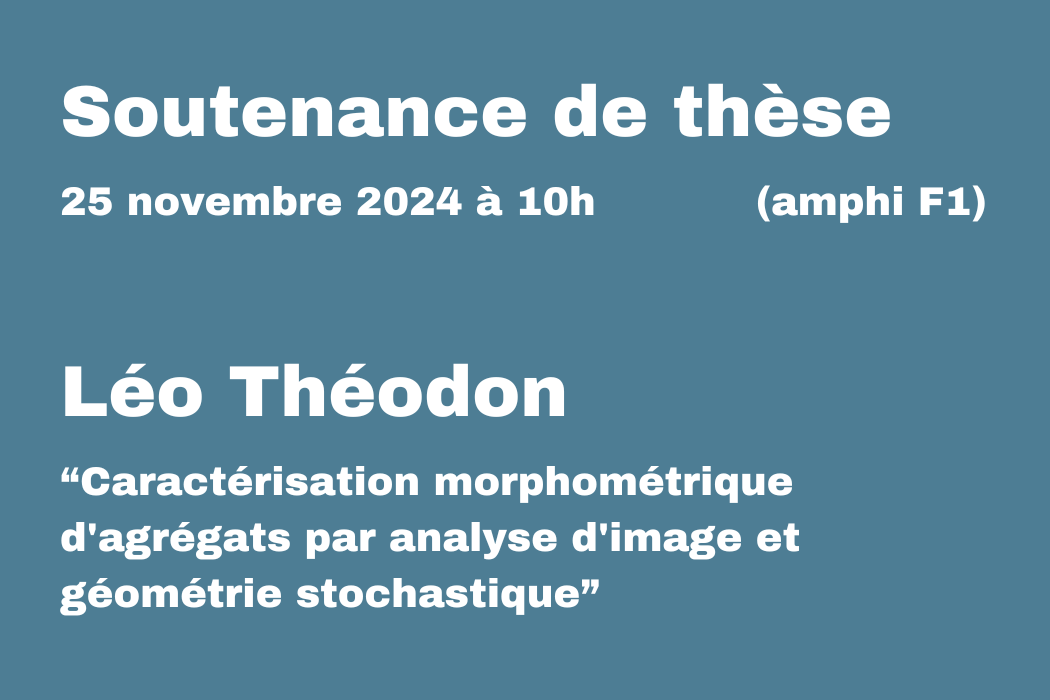
Léo Théodon will defend his thesis entitled “Morphometric characterization of aggregates using image analysis and stochastic geometry” on November 25, 2024, at 10:00 AM in lecture hall F1 of the main building of École des Mines de Saint-Étienne (158 cours Fauriel, 42100 Saint-Étienne).
The defense will be followed by the traditional thesis reception, to which participants are cordially invited.
Jury
- Hermine Bierme, Professor, University of Tours (reviewer)
- Maxime Moreaud, Senior Researcher (HdR), IFPEN Solaize (reviewer)
- Mohamed Daoudi, Professor, IMT Nord Europe (examiner)
- Anne Estrade, Professor, Université Paris Cité (examiner)
- Bruno Figliuzzi, Assistant Professor (HdR), Mines ParisTech (examiner)
- Jérôme Yon, Professor, INSA Rouen Normandie (examiner)
- Christine Frances, CNRS Research Director, University of Toulouse (guest)
- Carole Coufort-Saudejaud, Associate Professor, University of Toulouse (co-supervisor)
This thesis was supervised by Johan Debayle.
Abstract
This thesis is part of the MORPHING project funded by the French National Research Agency (ANR) and an industrial issue raised by the company ARKEMA. Its aim is to develop methods to characterize the 3D morphology of latex nanoparticle aggregates in an industrial context, based on in-situ 2D images. Indeed, the morphological properties of these aggregates strongly influence the quality of finished products and process efficiency, but can only be estimated through imaging under production conditions.
The thesis addresses this issue from two complementary angles: a scientific approach aimed at developing 3D stochastic geometric models exploiting 2D information from image analysis, and an industrial approach targeting near-real-time implementation. Several contributions are made, notably three original stochastic geometric models enabling the generation of 3D aggregates from 2D morphometric measurements, as well as a deep-learning generative model to directly estimate 3D morphology from 2D images.
These approaches are validated numerically and experimentally on in-situ and ex-situ images. The results show that the purely stochastic geometric approach offers slightly higher accuracy, while the deep-learning approach is better suited to an industrial context due to its speed and ease of implementation. Areas for improvement are identified regarding the quality of the experimental data and the optimization of the models.
This thesis thus opens up new perspectives for the 3D morphological characterization of aggregate populations through 2D image analysis, by proposing efficient methods applicable under industrial conditions. Its results may benefit many processes for which morphological control of products is a key issue.
Related Posts